How to Calculate Your Income Tax in Sri Lanka
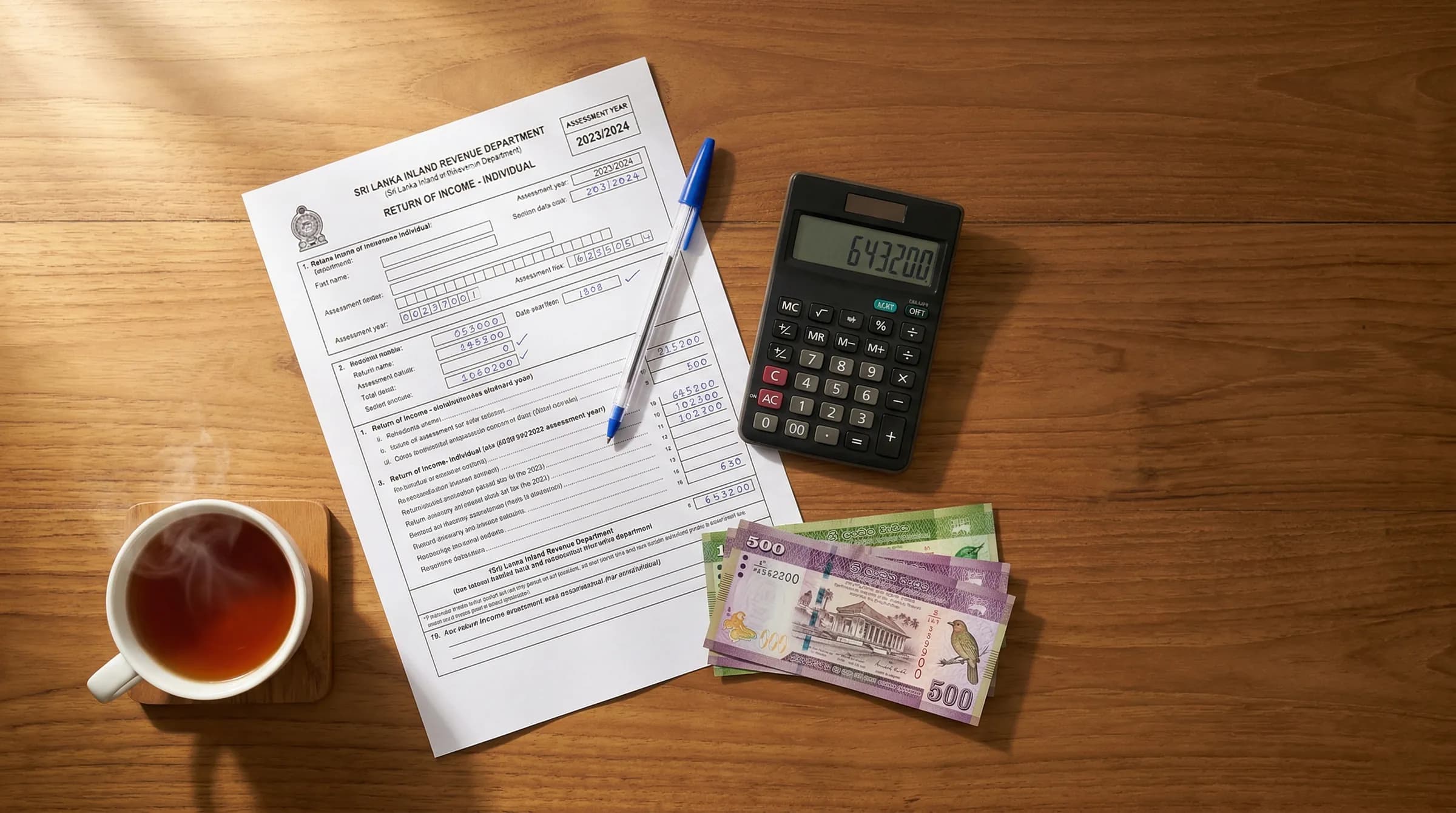
Most Sri Lankans think income tax is complicated. It's not. The calculation follows five steps, and once you see them laid out with real numbers, you'll wonder why it ever seemed confusing.
This guide walks you through exactly how your income tax is calculated under the Inland Revenue Act for the Year of Assessment 2025/2026 (April 1, 2025 to March 31, 2026). We'll use a realistic example so you can follow along and apply the same logic to your own situation.
How do I total my income across all sources?
Start by totalling your gross income across all sources. Under Sri Lankan tax law, income falls into a few categories:
- Employment income covers salary, wages, bonuses, and benefits from your employer (local or foreign)
- Business income means revenue from freelancing, consulting, or business activities, minus allowable business expenses
- Investment income includes dividends, interest, rental income, capital gains, and winnings
- Other income captures anything that doesn't fit the categories above
If you earn in foreign currency (USD, EUR, GBP, etc.), you must convert to LKR using the official Central Bank of Sri Lanka exchange rate on the date of receipt. Not the date you invoiced. The date the money hit your account.
For business income, your gross revenue isn't what gets taxed. You subtract allowable business expenses first. If you earned Rs. 6,000,000 in freelance income but had Rs. 1,200,000 in legitimate expenses, your business income for tax purposes is Rs. 4,800,000.
Our example
Let's say you're a freelancer with the following income for YoA 2025/2026:
| Source | Amount (LKR) | Treatment |
|---|---|---|
| Freelance business income (after expenses) | 4,800,000 | Progressive |
| Interest on savings (Rs. 12,000 final WHT already deducted) | 120,000 | Final, excluded |
| Total income subject to progressive tax | 4,800,000 |
Bank interest paid to resident individuals is subject to 10% final Withholding Tax under Section 88(1)(b) of the Inland Revenue Act. The Rs. 12,000 that the bank withheld is the complete tax on that interest. It stays out of the progressive calculation below, and you do not claim it as a credit later. We cover the distinction between final and creditable WHT in detail in our APIT vs WHT reference.
How does personal relief work in Sri Lanka?
Every resident individual in Sri Lanka gets personal relief. For YoA 2025/2026, personal relief is Rs. 1,800,000.
This means the first Rs. 1,800,000 of your income is effectively tax-free.
| Amount (LKR) | |
|---|---|
| Total income subject to progressive tax | 4,800,000 |
| Less: Personal relief | (1,800,000) |
| Income after relief | 3,000,000 |
Personal relief increased from Rs. 1,200,000 (YoA 2024/2025) to Rs. 1,800,000 for YoA 2025/2026 under the IR Amendment Act No. 2 of 2025. This is a significant change that benefits every taxpayer.
What qualifying payments can I deduct?
Qualifying payments are specific deductions allowed under the Inland Revenue Act. These include:
- Donations to approved charities (capped at the lesser of 1/3 of taxable income or Rs. 75,000)
- Donations to the Government of Sri Lanka
- Film production expenditure (minimum Rs. 5,000,000)
- Cinema construction expenditure (capped at Rs. 25,000,000)
These come off your income after personal relief. Not everyone has qualifying payments, so if you don't, skip straight to Step 4.
For our example, we'll assume no qualifying payments:
| Amount (LKR) | |
|---|---|
| Income after relief | 3,000,000 |
| Less: Qualifying payments | 0 |
| Taxable income | 3,000,000 |
What are the YoA 2025/2026 progressive tax slabs?
Sri Lanka uses a progressive tax system. Different portions of your income get taxed at different rates. You only pay the higher rate on the income that falls within that slab, not on everything below it.
Here are the tax slabs for YoA 2025/2026 (updated under the IR Amendment Act No. 2 of 2025):
| Taxable Income Slab | Tax Rate |
|---|---|
| First Rs. 1,000,000 | 6% |
| Next Rs. 500,000 | 18% |
| Next Rs. 500,000 | 24% |
| Next Rs. 500,000 | 30% |
| Balance above Rs. 2,500,000 | 36% |
If you're familiar with last year's slabs, you'll notice the 12% bracket is gone. The Amendment Act removed it entirely for 2025/2026. The first bracket also expanded from Rs. 500,000 to Rs. 1,000,000 at 6%, but the jump from 6% straight to 18% means some taxpayers actually pay more than before.
How this works in practice
Your taxable income of Rs. 3,000,000 gets split across the slabs like this:
| Slab | Income in Slab | Rate | Tax |
|---|---|---|---|
| First Rs. 1,000,000 | 1,000,000 | 6% | 60,000 |
| Next Rs. 500,000 | 500,000 | 18% | 90,000 |
| Next Rs. 500,000 | 500,000 | 24% | 120,000 |
| Next Rs. 500,000 | 500,000 | 30% | 150,000 |
| Balance | 500,000 | 36% | 180,000 |
| Total | 3,000,000 | 600,000 |
Your calculated tax is Rs. 600,000.
A common misconception: if you fall into the "36% bracket," people think all your income is taxed at 36%. That's not how it works. Only the Rs. 500,000 above the Rs. 2,500,000 threshold gets the 36% rate. The first million is still taxed at just 6%.
Which tax credits can I subtract from my final liability?
The last step is subtracting any tax credits you've already paid that are creditable against your final liability. Not every tax deducted at source qualifies. Final WHT (interest, dividends) is settled separately and never enters this calculation.
Withholding Tax (WHT) credits
Sri Lanka splits WHT into two distinct buckets:
- Final WHT: bank interest (10%), dividends from resident companies (15%), winnings (14%). The deduction at source is the complete tax on that income. You don't add the income to your total, and you don't claim a credit. The interest in our Step 1 example (Rs. 12,000 WHT on Rs. 120,000) falls into this bucket, already settled, never enters this Step 5.
- Creditable WHT: rent of Rs. 100,000 or more per month, taxed at 10% under Section 84A(1A). The rent IS added to total income, and the WHT is subtracted as a credit under Section 89(2). Our freelancer example has no rent income, so no creditable WHT applies.
For a deeper breakdown with section citations, see our APIT vs WHT reference.
Advance Personal Income Tax (APIT) credits
If you're employed and your employer deducts APIT from your salary, those amounts are creditable against your annual tax liability under Section 89(2). Your employer should give you a T-10 certificate documenting these deductions. Our freelancer example has no APIT.
Quarterly tax payments already made
If you've been making quarterly tax payments (due August 15, November 15, February 15, and May 15), those are also credited against your final liability.
Final calculation
| Amount (LKR) | |
|---|---|
| Calculated tax (progressive) | 600,000 |
| Less: Quarterly payments made | (200,000) |
| Tax still payable | 400,000 |
The Rs. 12,000 final WHT on interest is already settled. It does not appear in this calculation. The freelancer pays only the Rs. 400,000 balance.
This remaining balance is due by September 30 following the end of the tax year. For YoA 2025/2026, that's September 30, 2026. Miss this deadline and you're looking at a 20% penalty on the unpaid amount, plus compound interest at 1.5% per month.
What about final WHT income?
Some types of investment income are subject to "final" Withholding Tax. This means the WHT deducted at source is the complete tax on that income. It doesn't get added to your total income for the progressive calculation at all.
Final WHT income types include:
- Bank interest paid to resident individuals (10% final WHT, Section 88(1)(b))
- Dividends from resident companies (15% final WHT, Section 88(1A)(aa))
- Winnings and prizes (14% final WHT)
So if you received Rs. 200,000 in dividends and Rs. 30,000 WHT was deducted, that dividend income stays out of your progressive tax calculation entirely. The Rs. 30,000 is the final tax on it. You don't owe anything more, and you don't claim a credit for it. The same logic applies to the Rs. 120,000 of bank interest in our Step 1 example: settled, separate, done.
Senior citizens (aged 60 or older) are entitled to a Rs. 1,500,000 per year exemption on interest income from financial institutions, on declaration to the bank. Interest above that threshold remains subject to the 10% final WHT.
Does the 15% cap apply to my foreign income?
If you're a freelancer earning foreign currency from clients abroad (what the IRD calls an "Individual Service Exporter"), you may qualify for a concessionary maximum tax rate of 15% instead of the standard rates that go up to 36%.
This applies from YoA 2025/2026 onwards and can make a significant difference. A freelancer earning Rs. 8,000,000 in foreign income would pay substantially less under the 15% cap than through the standard progressive slabs.
For the full breakdown of how this works, including eligibility requirements, see our detailed guide on freelancer tax changes.
What is the Year of Assessment in Sri Lanka?
One thing that trips up many people: the tax year in Sri Lanka doesn't follow the calendar year. The Year of Assessment (YoA) runs from April 1 to March 31.
- YoA 2024/2025: April 1, 2024 to March 31, 2025
- YoA 2025/2026: April 1, 2025 to March 31, 2026
When calculating your tax, make sure you're including income and expenses from the correct 12-month period. An invoice you raised in March 2026 but got paid for in April 2026 counts towards the next tax year, because the receipt date is what matters.
What if you have foreign employment income?
If you're working remotely for a foreign employer, the calculation follows the same five steps. But there are some nuances around how foreign employment income is categorised and whether WHT applies. We've covered this in detail in our guide to foreign employment income tax.
What are the 2025/2026 tax numbers at a glance?
Here's everything in one place for easy reference:
| Item | Value |
|---|---|
| Personal relief | Rs. 1,800,000 |
| Tax slab 1 | First Rs. 1,000,000 at 6% |
| Tax slab 2 | Next Rs. 500,000 at 18% |
| Tax slab 3 | Next Rs. 500,000 at 24% |
| Tax slab 4 | Next Rs. 500,000 at 30% |
| Tax slab 5 | Balance at 36% |
| ISE foreign income cap | 15% maximum |
| Interest WHT (resident individual) | 10% (final) |
| Dividend WHT (resident company) | 15% (final) |
| Rent WHT (≥ Rs. 100,000/month) | 10% (creditable) |
| Quarterly payment dates | Aug 15, Nov 15, Feb 15, May 15 |
| Balance payment deadline | September 30, 2026 |
| Late balance penalty | 20% of unpaid amount |
For more on choosing the right tool to manage all of this, see our comparison of tax software options available in Sri Lanka.
Frequently asked questions
Quick answers to common questions on this topic.
What is the personal relief for YoA 2025/2026?
For the Year of Assessment 2025/2026, every resident individual in Sri Lanka receives a personal relief of Rs. 1,800,000. This is up from Rs. 1,200,000 in the previous year under the Inland Revenue Amendment Act No. 2 of 2025.
What are the progressive tax slabs for 2025/2026?
Taxable income is taxed at 6% on the first Rs. 1,000,000, 18% on the next Rs. 500,000, 24% on the next Rs. 500,000, 30% on the next Rs. 500,000, and 36% on any balance above Rs. 2,500,000. The 12% bracket from prior years was removed by the Amendment Act.
When does the Sri Lankan tax year start and end?
The Year of Assessment runs from April 1 to March 31. YoA 2025/2026 covers April 1, 2025 through March 31, 2026. Income is recognised on the date it was received, not the date it was invoiced, so a March invoice paid in April falls into the next tax year.
How is foreign currency income converted to Sri Lankan Rupees for tax?
Foreign currency income must be converted to LKR using the official Central Bank of Sri Lanka exchange rate on the date the payment was received. The invoice date does not matter for tax purposes. Only the date the money was credited to your bank account is used.
What is the difference between final WHT and creditable WHT?
Final WHT is the complete tax on that income and is excluded from your progressive calculation entirely. Examples include 10% on bank interest paid to resident individuals (Section 88(1)(b)) and 15% on dividends from resident companies. Creditable WHT, such as 10% on rent of Rs. 100,000 or more per month, is added to your total income and subtracted from your final tax liability as a credit under Section 89(2).
When is the balance income tax payment due?
The balance of any remaining tax not covered by quarterly instalments, WHT, or APIT is due by September 30 following the end of the tax year. For YoA 2025/2026, that is September 30, 2026. Late balance payments attract a 20% penalty plus compound interest at 1.5% per month.
Do freelancers earning foreign income pay the standard progressive rates?
No. Sri Lankan freelancers receiving foreign currency through a bank for services consumed outside Sri Lanka qualify for a concessionary maximum tax rate of 15% under the Individual Service Exporter rules from YoA 2025/2026, instead of the standard rates that go up to 36%.
Related reading
All articles →
Tax Exempt Income in Sri Lanka: Is Your Money Taxable?
Is your EPF, lottery win, pension or share gain tax exempt in Sri Lanka? Check each receipt against the Inland Revenue Act's list of exempt amounts.

Tax Relief vs Exemption vs Credit in Sri Lanka
Relief, exemption, qualifying payment, tax credit: four Sri Lankan tax words that work at different steps. One worked example shows where each one applies.

Money From Family Abroad: Is It Taxable in Sri Lanka?
Is money your family sends from abroad taxable in Sri Lanka? See where the Inland Revenue Act draws the line between a gift and income, and what records to keep.