APIT for Sri Lankan Employees: A Beginner's Guide
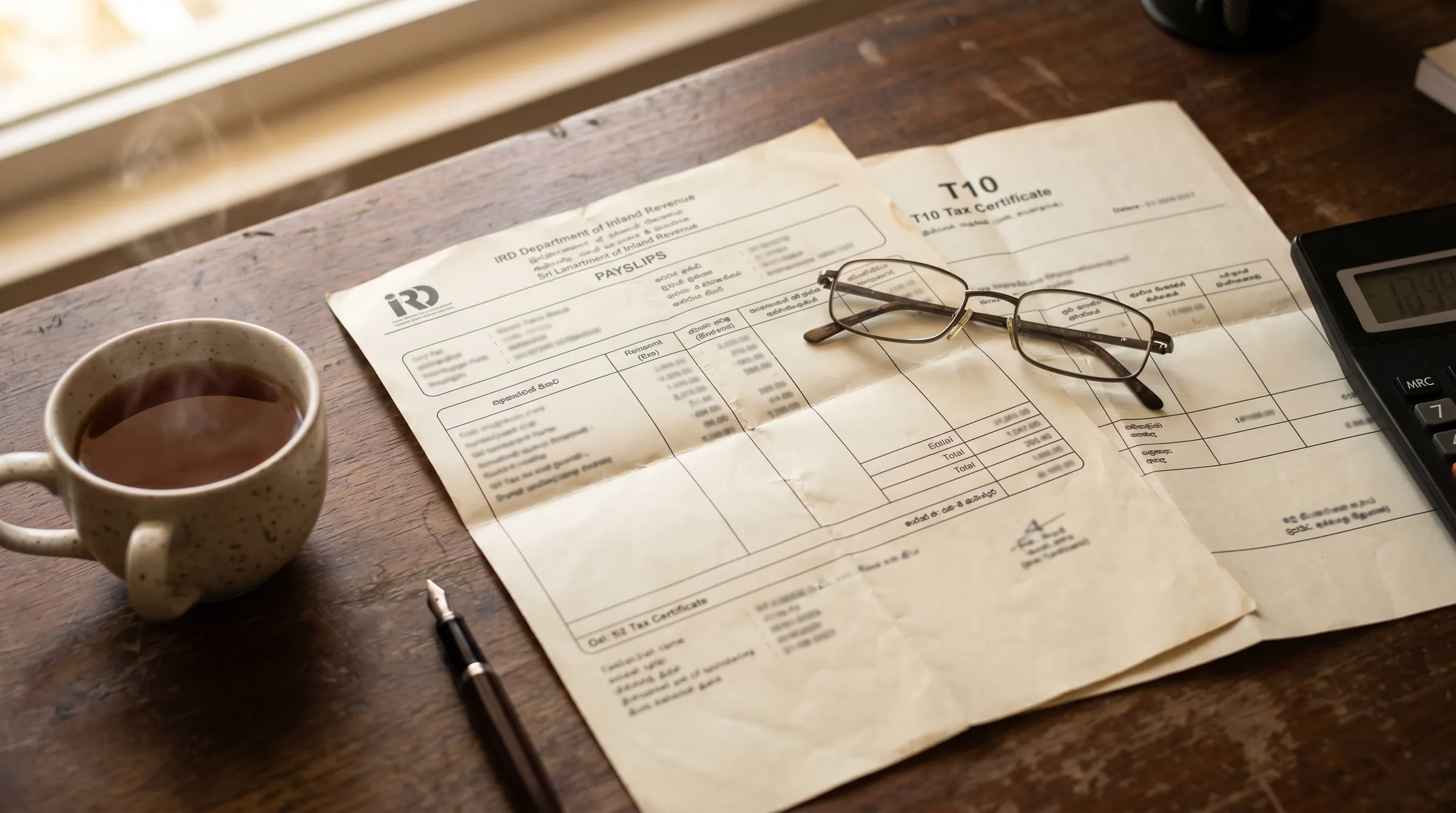
The line on your payslip that says "APIT" or "income tax" isn't the company taking a cut. It's tax that's already being paid to the Inland Revenue Department on your behalf, before the rest of your salary lands in your bank account. Most Sri Lankan employees see this line for years without ever really understanding it. This article walks through what APIT actually is, how it's calculated, what the T10 certificate at year end means, and what you should do with it.
If you're brand new to tax, you don't need to read it cover to cover. Skim the sections that matter to you and come back to the rest when something on your payslip stops making sense.
What is APIT and why does my employer deduct it?
APIT stands for Advance Personal Income Tax. It's the system Sri Lanka uses to collect income tax from employees in monthly instalments instead of one big bill at the end of the year. Your employer calculates what your tax should be for the month, takes that amount out of your gross pay, and sends it to the Inland Revenue Department (IRD).
The key word is "advance." You're not paying a separate tax. You're pre-paying your annual income tax bill, twelve months at a time, through your employer.
APIT replaced the older PAYE (Pay-As-You-Earn) system when the Inland Revenue Act, No. 24 of 2017 came into operation. The mechanism is the same. The name changed and the tax tables changed with it. Many people still say "PAYE" out of habit, but the official term is APIT.
Is APIT optional or mandatory in Sri Lanka?
Mandatory. Since January 1, 2023, every employer is legally required to deduct APIT from any employee whose monthly regular profits exceed the tax-free threshold, regardless of whether the employee asks for it.
Between April 2020 and December 2022, the rules were different. APIT was opt-in for resident citizens during that window. That's now closed. If your monthly pay clears the threshold, the deduction happens automatically. You can't ask your employer to stop.
How does my employer calculate my monthly APIT?
For a resident employee in their primary job, the calculation uses Tax Table No. 01 issued by the IRD for the Year of Assessment 2025/2026. The Rs. 1,800,000 annual personal relief is already baked into the table as Rs. 150,000 per month, so the first Rs. 150,000 of monthly income carries no APIT.
| Monthly regular profits (Rs.) | APIT formula |
|---|---|
| Up to 150,000 | Nil |
| 150,001 – 233,333 | (Monthly profit × 6%) – 9,000 |
| 233,334 – 275,000 | (Monthly profit × 18%) – 37,000 |
| 275,001 – 316,667 | (Monthly profit × 24%) – 53,500 |
| 316,668 – 358,333 | (Monthly profit × 30%) – 72,500 |
| Over 358,333 | (Monthly profit × 36%) – 94,000 |
"Monthly regular profits" means your basic salary plus most allowances, plus the fair market value of non-cash benefits like a company vehicle or housing.
Worked example. You earn a gross salary of Rs. 250,000 per month including allowances. That puts you in the Rs. 233,334 to 275,000 bracket.
| Step | Calculation | Result (Rs.) |
|---|---|---|
| Monthly profit | 250,000 | 250,000 |
| Apply formula | (250,000 × 18%) – 37,000 | 8,000 |
| Monthly APIT | 8,000 | |
| Annual APIT (× 12) | 96,000 |
So Rs. 8,000 a month, Rs. 96,000 over the year, flows from your payroll to the IRD before you ever see it.
Bonuses, arrears, and one-off lump sums use a different table (Table No. 02). If you have a second job, your secondary employer uses Table No. 07 unless you give them your primary-employment declaration.
How does the employer pay APIT to the IRD?
Every month, your employer pools the APIT deducted from every employee on the payroll and pays it as a single sum to the IRD.
- Deadline: on or before the 15th of the following month. APIT deducted in May must reach the IRD by June 15.
- Where: any branch of the Bank of Ceylon, using the IRD-specified remittance form.
- Annual statement: by April 30 after the Year of Assessment ends, the employer also files an annual statement with the IRD showing every employee's full-year totals.
You don't have to do anything for this part. It happens whether or not you're paying attention.
What is the T10 certificate and when do I get it?
The T10 (sometimes written T-10) is the official tax deduction certificate your employer issues to you at the end of the year. It's the receipt for all that monthly APIT.
It shows two key numbers:
- Your total gains and profits from employment for the Year of Assessment.
- The total APIT withheld by that employer over the same period.
Your employer must issue the T10:
- By April 30 immediately after the end of the Year of Assessment, or
- Within 30 days of your last working day if you leave the job mid-year.
If you've changed jobs during the year, you'll get one T10 per employer. Hold on to all of them.
Treat the T10 like a financial document, not a payroll printout. Save a scan or PDF in a labelled folder by Year of Assessment. If you need to claim a refund or file a return three years later, you'll still have it. Paper copies fade and go missing.
What should I do after I receive my T10?
This is where most employees zone out, and where mistakes (or missed refunds) happen. APIT is what's called a creditable tax. For residents and non-resident citizens, the APIT your employer withheld is not your final bill. It's a deposit toward your actual annual tax liability.
"Creditable" means the APIT counts as tax already paid. At year end, you (or your tax adviser) work out your real tax liability for the year, then subtract the APIT already withheld. If APIT exceeded your real liability, you're owed a refund. If it fell short, you owe the difference. Our final vs creditable WHT explainer covers this distinction in more depth.
So your year-end checklist looks like this:
- Collect every T10. One from each employer you worked for during the year.
- Total up your other income. Investment income, rent, side gigs, freelance earnings, anything not on a payslip.
- Calculate your actual annual tax. Use the IRD's progressive slabs, deduct your personal relief and any other reliefs you qualify for (rent, solar). Our income tax calculation guide walks through this step by step.
- Compare. Subtract the APIT credit (from your T10s) and any other withholding tax from your calculated annual tax.
- File a Return of Income if required. Attach your T10s, pay any balance, or claim your refund.
If you had a second job, freelance income, investment income, or non-cash benefits your employer didn't include in your APIT calculation, APIT alone won't have covered your full tax liability. Expect to owe a balance at year end. Ignore the gap and Section 178 penalties plus 1% per month interest start running on the underpayment. If your side income is significant, consider quarterly tax instalments on top of your salary's APIT.
How does Taxable help employees keep track of APIT and the T10?
For most employees with one job and no side income, APIT does the whole job and the T10 sits in a folder until the day they need it. But the moment your situation gets a bit more complex (a second income stream, an investment portfolio, a remote job for a foreign employer, a year with both employment and freelance income), the year-end reconciliation gets fiddly.
Taxable lets you log each T10 against the Year of Assessment, add any other income, and see the gap between APIT already paid and your actual liability. If you owe a balance, Taxable shows the deadline. If you're owed a refund, it tells you exactly how much.
You can't opt out of APIT, but you can stop being confused by it. Once you understand what your payslip is doing, the T10 stops being a mystery document and becomes what it actually is. A receipt for tax already paid, on your behalf, by someone else.
Frequently asked questions
Quick answers to common questions on this topic.
Is APIT the same as PAYE?
APIT is the successor to PAYE. The Inland Revenue Act, No. 24 of 2017 replaced the old PAYE system with APIT (Advance Personal Income Tax). The mechanism is the same, your employer withholds tax from your salary each month, but the name and the underlying tax tables have changed. People still say PAYE colloquially, but the official term since 2018 is APIT.
Can I refuse APIT deduction from my salary?
No. Since January 1, 2023, APIT has been mandatory for all employees whose monthly regular profits exceed the tax-free threshold. The deduction does not require your consent. Your employer is legally required to withhold APIT on every payslip and remit it to the Inland Revenue Department on your behalf each month.
What is the monthly APIT-free threshold for Sri Lankan employees?
For the Year of Assessment 2025/2026, no APIT is deducted on monthly regular profits up to Rs. 150,000. This is the monthly equivalent of the Rs. 1,800,000 annual personal relief built into Tax Table No. 01. If your monthly pay including allowances stays at or below Rs. 150,000, your employer should not deduct any APIT.
When does my employer have to issue my T10?
By April 30 immediately after the end of the Year of Assessment. If you leave a job mid-year, your previous employer must issue your T10 within 30 days of your last working day. The T10 shows your total employment income and the total APIT withheld during your time with that employer.
Is APIT my final tax bill?
For most Sri Lankan employees, residents and non-resident citizens, APIT is not a final tax. It is a creditable pre-payment toward your annual tax liability. If your APIT exceeded what you actually owe, you can claim a refund. If it fell short, you pay the balance. Only non-resident non-citizens treat APIT as final.
Do I have to file an annual tax return if APIT was deducted?
Sometimes. If APIT covered your full tax liability and you have no other taxable income, you may not need to file. But if you had multiple employers, side income, non-cash benefits not captured in APIT, or you want to claim a refund, you should file an annual Return of Income and attach your T10 as required by Section 93(2)(b)(i).
What if I had two jobs in the same year?
You will receive a T10 from each employer. Both must be reported on your annual return. If you transitioned mid-year, you were supposed to give your old T10 to your new employer so they could use Tax Table No. 05 to cumulatively apply the correct deduction. If they didn't, expect to owe a top-up at year end.
Related reading
All articles →
Employee to Freelancer Mid-Year: How to File in Sri Lanka
Left a salaried job to freelance mid-year in Sri Lanka? Your old APIT becomes a tax credit, both phases go on one return, and instalments use last year's tax.

Double Taxation in Sri Lanka: Do You Pay Tax Twice?
Already paid tax abroad? Sri Lanka taxes residents on foreign income, but a Section 80 foreign tax credit stops you paying in full twice. Here's how it works.

Online Seller Tax in Sri Lanka: What You Actually Owe
Selling on Daraz, Etsy or Instagram in Sri Lanka? Learn how your store income is taxed, which selling costs you can deduct, and when quarterly payments start.